
Student name
RSCH-FPX7864
Capella University
Professor Name
Submission Date
Part 1: Histogram
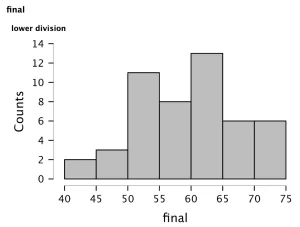
Figure 1
Lower Divi
sion
A histogram has been plotted, which indicates the distribution of all grades of lower-division students on final exams. Shreffler and Huecker (2023) suggest that histograms can be one of the most effective and simplest methods of exploring a data set and identifying patterns in said data. The food and beverage exam scores are equalized in terms of the number of students who were graded by respective ranges of 5 points between 40 and 75 points. The highest score with the greatest number of students is numerically in a modal range of 60-65 (13 students).
The frequency distribution as a whole has a negative skew, indicating that there is a high proportion of students whose scores are below the median score of about 60, as compared to the number of students whose score exceeds that median score. The skewed distribution of frequencies shows that most of the scores within this sample are more common at the upper end of the scoring categories, and they only decrease to a lesser extent at the other end of the scoring categories.
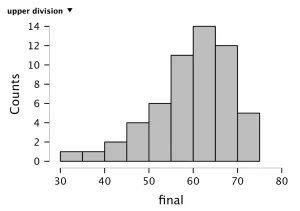
Figure 2
Upper Division
The histogram is a range of 5-point score ranges of 30-80 scores, whereby there were ranges of scores where the number of students who achieved that score on the final exam was represented. The histogram has two variables: the independent variable is the final examination mark, and the dependent variable is whether a student is in an upper division or not. As such, the histogram has been configured into intervals to readily determine the ranking of the student performance, besides the ability to evaluate the proportion of student representation in each interval.
The largest concentration of the students (14 out of 56 sampled students) was in the 65-70 range. According to Scheer et al. (2022), histograms are an extremely useful format of graphs that are widely practiced in various fields to visually represent the distribution of a variable number of incidents among the available options. The shape of the histogram is that of a bell, symmetric around the center of the histogram, which means that the data distribution underlying the histogram is close to the normal distribution.
Part 02: Descriptive Statistics
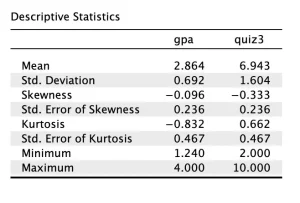
Table 1
Descriptive Statistics
Descriptive statistics, comprising the mean, standard deviation, skewness, and kurtosis, are important in identifying the trends of data distributions and also in identifying the central aspects of a dataset. Descriptive statistics give an overview of the appearance of data and what the key features of a sample are (Fulk, 2023). The close correlation between the mean and standard deviation values will mean that the data will be concentrated around the mean, and the bigger the difference between the two, the bigger the difference in the concentration of the data. With the GPA variable, the mean and the standard deviation were M = 2.864, SD = 0.692, respectively.
The sum of the values amounted to 3.556, and therefore, the concentration level was high, and the central tendency was high. Quiz 3 variable gave the results M= 6.943, SD=1.604, and upper limit= 8.547, which again demonstrates values that are concentrated and a high measure of central tendency. The other indices of normality in the distribution of the descriptive statistics are skew and kurtosis, beyond the central tendency (Hatem et al., 2022). Skew and kurtosis values of the GPA variable were found to be -0.096 and -0.832, respectively, and they are within the acceptable values of -2 and +2, so the distribution. Similarly, skewness and kurtosis values of -0.333 and 0.662, respectively, as produced by the Quiz 3 variable, are all far within acceptable normality ranges.
Conclusion
Descriptive statistics were applied to analyze the frequencies and measures of central tendency of the two groups of students. The distribution was skewed negatively in the first-year students, and it was concentrated between 60 and 65. In the second or upper-class students, the distribution was closer to normal and concentrated between 65 and 70.
In the case of GPA and Quiz 3, data of both groups was normally distributed to prove this based on the value of mean, standard deviation, skewness and kurtosis, with no one going defiant of the range of +2-2 of skewness and kurtosis; this also gives further validation to the claim that data of both variables were normally distributed and were largely centered around the means.