Student name
MHA-FPX5017
Capella University
Professor name
Submission date
Slide 1:
Hello all. My name is _________. This presentation will review the statistical results for nurse staffing and hospital-acquired conditions at St. Anthony Medical Center. It also gives an evidence-based recommendation, financial analysis, and phased implementation plan to make it easier for leadership to make a decision. The proposed initiative is to increase nursing hours per patient day to improve patient safety, reduce preventable complications, and improve organizational performance.
Slide 2:
Data Collection, Measurement & Analysis Tools & Techniques
The dataset contained observations from 95 hospital units or reporting periods. Staffing and patient-outcome variables were summarized using descriptive statistics. Pearson correlation analysis was then performed to examine the direction and strength of the relationships between nursing hours per patient day, nursing skill mix, average length of stay, and hospital-acquired condition rates. Multiple regression analysis was used to examine the degree to which staffing variables explained variance in HAC rates.
The regression model was statistically significant and accounted for 64.4% of the variance in HAC rates (R2 = .644). This suggests a significant portion of the variation in hospital-acquired conditions observed was explained by the variables included in the model. When statistical results are presented and interpreted effectively, healthcare leaders can transform complex data into actionable quality improvement decisions.
Limitations include the fact that the analysis was cross-sectional and the study was observational. Therefore, the findings demonstrate statistical associations but do not independently demonstrate causality. HAC rates also may be affected by patient acuity, type of unit, staff experience, organizational culture and adherence to infection-prevention practices.
Slide 3
Explanation of Statistical Findings
Correlation analysis revealed a strong negative correlation between hospital-acquired condition rates and nursing hours per patient day, r = −.799. This suggests that higher levels of nursing care were associated with lower rates of HACs. The regression coefficient also showed that for every additional hour of nursing HPPD, there were an estimated 4.16 fewer hospital-acquired conditions per 1,000 discharges, p = .021.
Statistical significance of the association between HPPD and HAC rates was confirmed as the p-value was less than .05. The model’s R² value of644 suggests that the predictors included in the analysis accounted for approximately 64.4% of the variability in HAC rates. But R² does not mean that we can be 64.4% confident in our results or that the outcomes were solely due to staffing.
Nursing skill mix was not a significant predictor of HAC rates (p =.247). The average length of stay was moderately positively correlated with the HAC rates, r = .417, suggesting that longer hospital stays resulted in increased exposure to preventable complications. Similarly, current evidence indicates that higher nurse staffing is tied to better patient outcomes, though measures of staffing and organisational conditions differ across studies (Dall’Ora et al., 2022).
Slide 4
Key Statistics to Support a Recommendation & Plan of Action
Three statistical findings support the recommendation to increase nursing HPPD at St. Anthony Medical Center. First, the negative correlation between HPPD and HAC rates, r = −.799, indicates that fewer hospital-acquired conditions were present in patients when additional nursing care hours were available. The regression estimate suggests that an additional nursing hour per patient day may reduce HAC rates by about 4.16 cases per 1,000 discharges.
Second, the regression model explained 64.4 percent of the variation in HAC rates. Although this does not imply causation, it does suggest that staffing-related variables have significant predictive value and should be considered in quality and workforce planning.
Third, skill mix was not statistically significant in the current model, p =.247. But this should not be understood as a sign that professional nursing qualifications are unimportant. There is systematic evidence that more registered nurse staffing is usually associated with better patient outcomes, whereas the evidence on substitution with other categories of nursing staff is less clear-cut (Dall’Ora et al., 2022).
The recommendation is therefore to increase total nursing HPPD whilst maintaining adequate RN oversight, competency standards, patient-acuity adjustments and safe delegation practices.
Slide 5
Recommendation & Action Plan
Statistical results support a nursing staffing increase at St. Anthony Medical Center from 3.94 to 6.0 HPPD. Nursing HPPD was strongly negatively correlated with HAC rates, r = −.799, p = .021 (Figure 1). More nursing care hours were associated with fewer hospital-acquired conditions.
The multiple regression results are shown in Figure 2. The model estimates a reduction of 4.16 HACs per 1,000 discharges for each additional nursing hour per patient day and explains 64.4% of the variation in HAC rates. In this analysis, nursing skill mix was not statistically significant, so the emphasis should be on increasing the overall availability of direct nursing care while maintaining safe professional oversight.
The organization’s staffing calculations indicate that 47 more full-time nursing positions would be needed to meet the proposed 6.0 HPPD target. Implementation should be based on patient acuity, turnover, occupancy, and nurse-sensitive quality indicators to determine staff allocation and should be prioritised for high-risk units.
Figure 1. There was a correlation between nursing hours per patient day and hospital-acquired condition rates (r = −.799, p < .05).
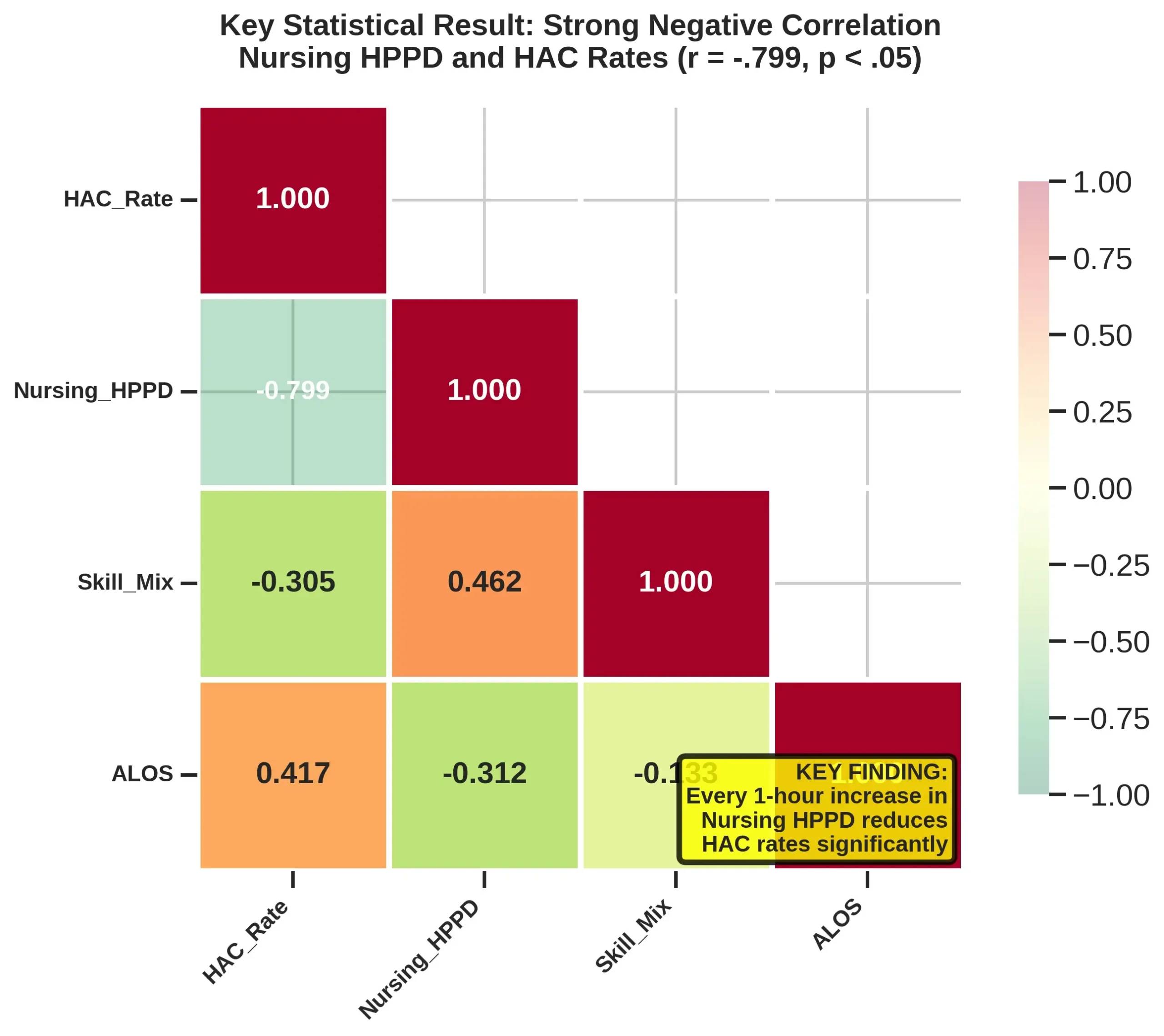
Insert scatterplot with HPPD on the horizontal axis and HAC rates per 1,000 discharges on the vertical axis.
Figure 2. Multiple regression coefficients for the effect of nursing HPPD and skill mix on HAC rates (R² =.644)
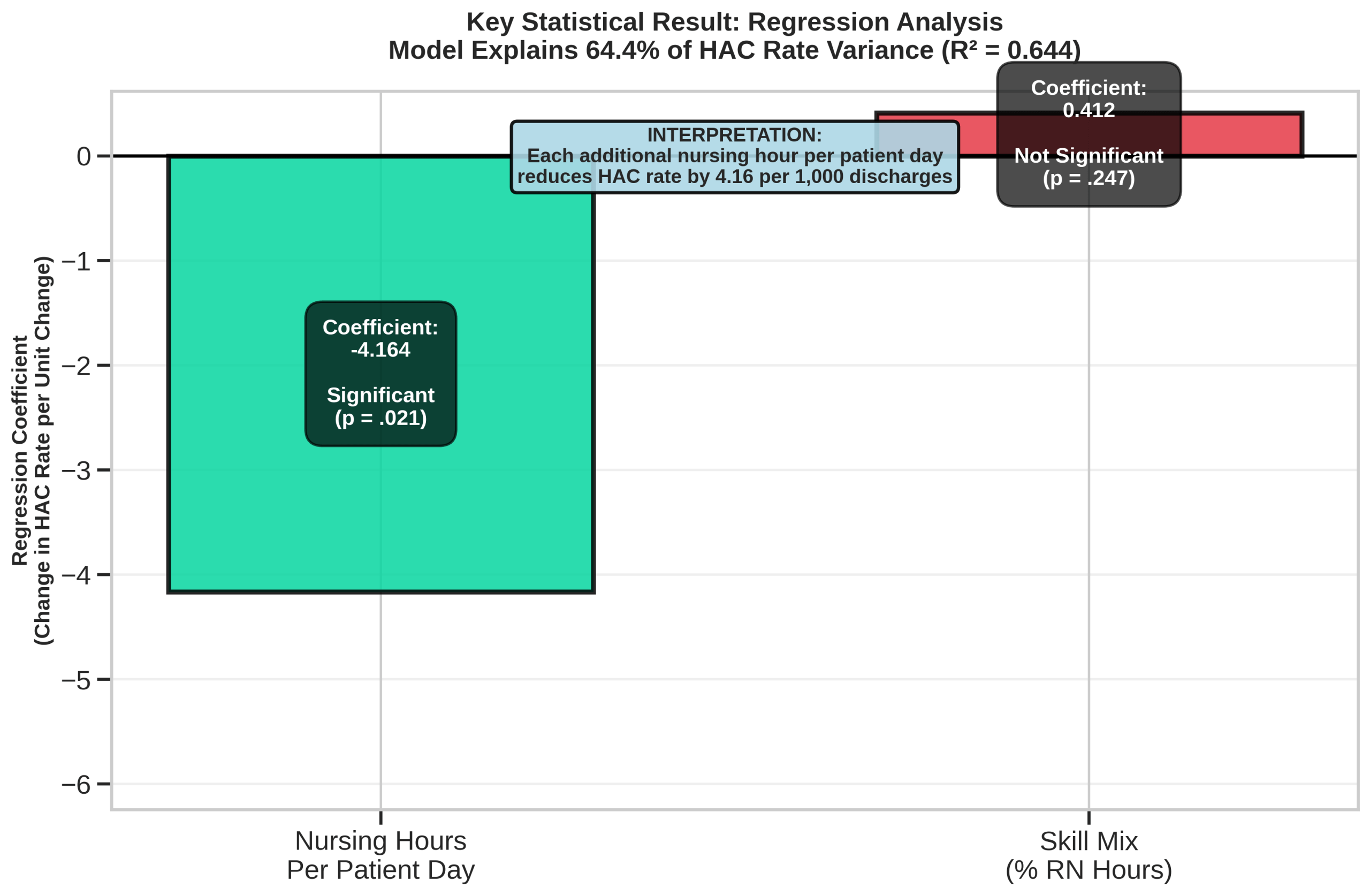
Insert the regression coefficient plot showing the effect size and statistical significance of each predictor.
Slide 6:
Cost-benefit analysis and implementation plan
The proposed staffing initiative would cost an estimated $3.39 million annually. Projected financial benefits include $256,000 from decreased length of stay and $489,000 from preventing an estimated 86 hospital-acquired conditions and associated penalties (Figure 3). These estimates translate into some $745,000 in measurable direct benefits. The remainder of the investment should be measured on longer-term outcomes such as improved staff retention, reduced overtime costs, fewer readmissions, better patient satisfaction, and improved regulatory performance in addition to reduced mortality.
Research also supports a generally positive relationship between increased RN staffing and patient safety outcomes (Dall’Ora et al., 2022).
Implementation will Take Place over 12 Months
Months 1-3: Planning and Recruitment
Complete workforce budget, select priority units, approve job descriptions, start recruitment, set baseline safety measures
Months 4-5: Recruitment and onboarding
Finalize hiring, validate competency, conduct clinical orientation, assign a preceptor and provide unit-based training.
Months 6-12: Full Implementation & Evaluation
Assign staff according to patient acuity and demand on the unit. Monthly tracking of HPPD and HAC rates, length of stay, overtime, staff turnover, patient satisfaction, and financial performance.
Figure 3. Cost-Benefit Analysis of the Initiative to Increase Nursing Staffing.
Add a table or bar graph showing the $3.39 million investment versus projected savings from reduced HACs and length of stay.
Slide 7
Conclusion
Statistical results support increasing nursing staffing at St. Anthony Medical Center to 6.0 HPPD. The strong negative correlation between HPPD and HAC rates r = −.799 and statistically significant regression coefficient p = .021 demonstrate that increased availability of nursing care is associated with fewer hospital-acquired conditions. The proposed staffing model is projected to prevent approximately 86 HACs and will improve patient safety, quality outcomes, workforce stability, and organisational performance. Staffing alone cannot be shown to have caused the reduction in HACs, but the findings are consistent with recent evidence linking adequate nurse staffing to safer patient outcomes.
The $3.39 million investment should be approved, subject to implementation that includes quarterly financial reviews, staffing based on patient acuity, monitoring of outcomes, and corrective action when performance targets are not met. Reducing hospital-acquired conditions also protects the organization from financial consequences, as CMS applies a 1 percent Medicare payment reduction to hospitals that fall in the worst quartile under the HAC Reduction Program.