Student Name
Capella University
BHA-FPX4020
Professor’s Name
Submission Date
Slide 1
Hi all, it’s Beth. In this presentation, I’m going to address the issue of falls among patients—this is what we have as an organization, Ascension St Vincent Hospital, right now. Next, I am going to give you some evidence-based practices that can help us address this critical problem. We all know that falls in patients continue to be one of the most frequent issues faced by healthcare organizations; when this happens, it can affect patients and the organization as well. It is strongly said that collaboration is key to our organisation, as we should all work together, both nurses and doctors, quality improvement specialists, and managers, to solve the problem.
Slide 2
Problem Statement
In the context of health care delivery, patient falls at Ascension St. Vincent Hospital may be considered a critical and preventable problem. The number of falls by patients in the institution is estimated to be approximately 5.5 falls per 1,000 patient days, which is higher than the benchmark range of 3 to 5 falls per 1,000 patient days set by the Agency for Healthcare Research and Quality (Agency for Healthcare Research and Quality, 2024).
Such poor results lead to more risks for patients’ health and well-being, hospitalization for a longer hospitalizations, reduced satisfaction levels of patients, as well as increased costs in healthcare delivery. The statement of the problem is developed using the principles of the SMART approach associated with the selected problem: In 1 year, Ascension St Vincent Hospital will reduce the number of patient falls by 20% with evidence-based interventions to help prevent falls.
Figure 01
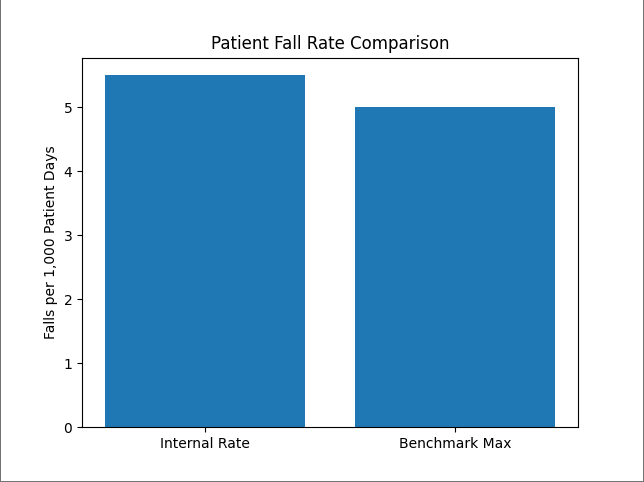
Comparison of Patient Fall Rates of Internal and National Benchmarks
Slide 3
Major Causes of the Problem
The issue of patient falls at Ascension St. Vincent Hospital is a problem with several interrelated system issues. First, a significant factor causing these problems is an inadequate practice of using standard tools for assessing patient risk factors, which implies not being able to identify high-risk patients promptly. However, there is also some variability in the use of protocols for fall prevention measures, such as rounds every hour, use of the appropriate assistive equipment, and effective patient observation (Turner et al., 2022).
The lack of staffing and workload makes it even more difficult to monitors patients constantly by health care providers. There may be further risks relating to poor lighting, limited space, and safety equipment. Lastly, certain drugs prescribed to patients, including sedatives and antihypertensive drugs, could impact patients’ balance and cognitive function, causing a fall risk (Imani et al., 2025). Such key performance indicators as patient fall incidents, compliance audit scores, staff-to-patient ratios, and environmental inspection scores assist in measuring the above-mentioned causes.
Slide 4
Data-Driven Action Plan
It is crucial to have a plan of action grounded in the literature and in-house resources for enhancing performance and reducing fall rates. The current internal data show that the number of patient falls is equal to 5.5 falls per 1,000 patient days. Therefore, the hospital needs to make adjustments to comply with the AHRQ fall rate of 3-5 falls per 1000 patient days (AHRQ, 2024). The result suggests a rate of 4.4 falls per 1000 patient days will be expected.
The following steps are to be taken in order to make sure that the rate decreases. To begin with, there needs to be a consistent process for assessing the fall risk for each patient at the institution. All patients are expected to be evaluated using the standardized tool, e.g., the Morse Fall Scale, at admission to the organisation. In this regard, it is expected that in 6 months 95% of the patients will be evaluated following the guidelines in place (Lee et al., 2025). The compliance of the staff with the intervention strategy will be assessed using EHR audits.
Other challenges to this intervention plan include implementing EHR dashboards that will allow for evaluating performance in terms of fall rates, protocol adherence, and identification of high-risk patients (Porta et al., 2025). Assessments will be made every month, and leadership teams will review results and trends and make any changes they deem necessary.
Furthermore, all fall incidents in the hospital setting will have to be completed with a mandatory RCA analysis within 72 hours. However, such intervention may face a few challenges due to limited time for hourly rounds in relation to the nurse-to-patient ratio, as well as a constraint related to updating the EHR software regarding its dashboard. The first issue can be tackled by implementing the intervention in risky settings first, while the second issue can be solved by integrating the new feature into the existing processes.
Thirdly, it would be recommended that the organization establish an interdisciplinary fall prevention team. This team will include nurses, doctors, quality improvement staff, and organizational leadership, and all will be responsible for coordinating the fall prevention programs in the organization. This team will be responsible for fall prevention review, root cause analysis, training, and continual application of the fall protocol. The research indicates that the involvement of various disciplines leads to better communication and fewer errors (Baumann et al., 2022).
While this is consistent with organizational culture and safety within the Ascension St. Vincent Hospital, it can pose some challenges, such as a lack of time among others. But commitment and delegating within the organization will help to solve such a problem. It is necessary to note that the recommendations mentioned above speak about the clinical approach, technological approach, and interdisciplinary approach in solving the problem within the organization.
Slide 5
Rationale for Executing the Recommendations
The use of the above evidence-based recommendations is therefore highly recommended both clinically and financially, as well as from a regulatory and strategic viewpoint, and this is therefore imperative in the organization. Currently, the organization’s patient fall rate (5.5 per 1,000 patient days) is higher than the national average (AHRQ, 2024), suggesting patients are not as safe and well as they should be. Besides clinical implications, there are several risks associated with falls, including fractures, head injury, morbidity, and mortality. The organization is therefore vulnerable to the risks of quality of patient-centered care delivery, in the event of a fall occurring.
Economic considerations also highlight the importance of using evidence-based recommendations for falls, as they are a driver of expensive health care costs. Literature indicates that patient falls result in higher costs because of longer length of stay in the hospital and liability issues (Dykes et al., 2023). Studies show that falls result in substantial losses that average up to several thousand dollars for each case. Furthermore, the Hospital-Acquired Condition Reduction Program (HACRP) with the CMS imposes up to a 1% penalty on underperforming hospitals, which falls under the safety measures domain (CMS, 2023).
Slide 6
Conclusion
Falls among patients at Ascension St Vincent Hospital are relevant as it has a significant impact on patient safety, the hospital’s financial standing, and its reputation. However, it must be acknowledged that this could be avoided. Thus, the development of an effective evidence-based action plan that would help reduce the rate of falls will become inevitable. To resolve the problem expressed above, a multifactorial approach will need to be implemented, such as the introduction of evidence-based practices and the use of a real-time monitoring system. Note that the actions mentioned are relatively feasible and aligned with the objectives of the chosen organisation. They will offer patients good health care services.
[/blur_section]